
Who Are We in This Era? ─ Mumble Jumble #
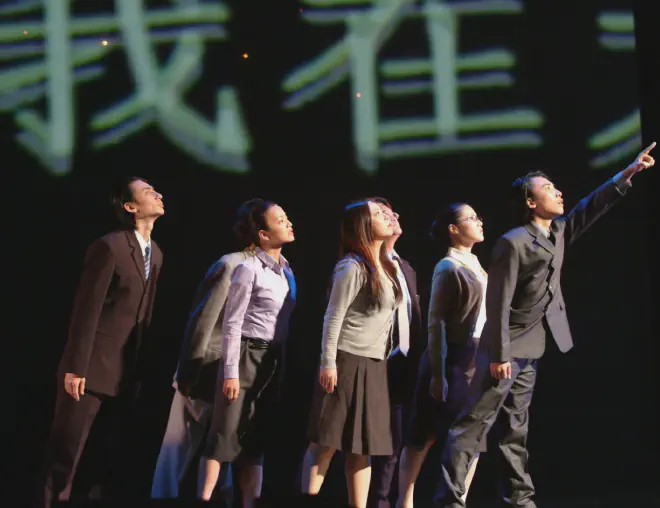
The Blurred Aesthetics of Theater #
Have you ever tried playing a 20-year-old game on the latest 4K screen? Every pixel looks coarse and obvious. But if you switch back to a CRT monitor from that era, the characters suddenly come alive. This is because the blurriness of old display technology allows the brain to actively fill in details, creating room for imagination.
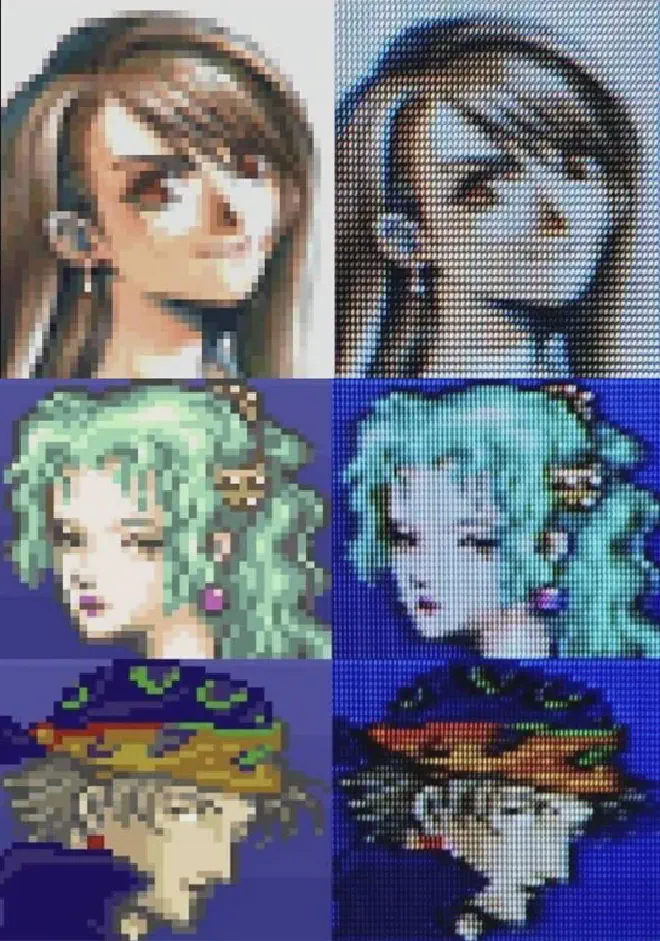
Left: Original image. Right: Displayed via CRT television.
Image source: CRT Pixels 📺 Twitter / CRTpixels
This makes me wonder: In an era of such advanced imaging technology, why do we still need theater?
The common answers are: “Because the tension of live performance is irreplaceable,” “Because the immediacy and interactivity of the stage cannot be matched by film or television.” But these answers mostly address the differences in “performance itself,” not the unique qualities of “theatrical text.”
What truly sets theater apart from film and television is “ambiguity.” This ambiguity comes from the blank spaces in dialogue and the layered metaphors in the narrative. It makes the audience not just viewers but participants in interpretation, co-creators of the text. Some feel exhilarated, while others are left with questions. This uncertainty is the magic of theater.
And Mumble Jumble is the ultimate showcase of “blurred aesthetics.”
A Subversive Political Allegory #
In 2003, Performance Workshop presented Mumble Jumble, a political satire stage play like no other. Its title parodies the then-popular political satire show “全民亂講” (Everyone’s Talking Nonsense), but unlike the latter’s short skits, Mumble Jumble is more like a tightly structured, multi-layered theatrical experiment.
The full footage of this play can still be found online, albeit with copyright concerns, giving the new generation a chance to experience this classic work.
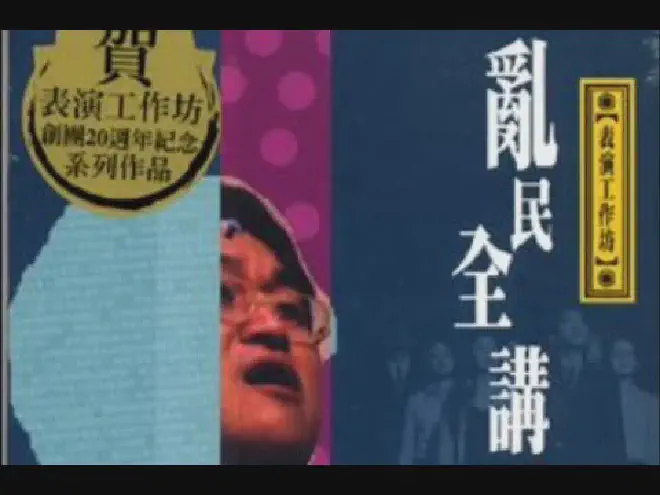
Watch here: https://www.youtube.com/watch?v=VYw1bFc63DE
The core of this work lies in its profound observation and critique of society. “Democratization” sharply satirizes procedural pseudo-democracy; “Media” exposes the shallowness and manipulation of news; “Globalization” portrays the absurdity and misunderstandings of cultural gaps; and “National Prison” highlights the survival struggles under high housing prices. Shockingly, these issues remain relevant 20 years later, even more pressing than before. Was this play ahead of its time, or has our society been stagnant?
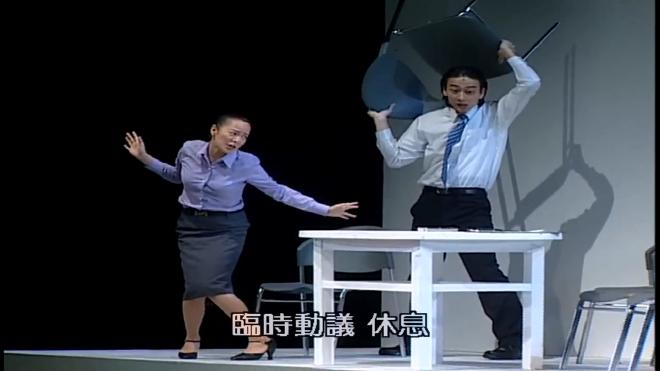
But the brilliance of Mumble Jumble is not limited to its straightforward political satire. It also hides a subtle emotional thread—those seemingly unclassifiable segments like “Flash Mob,” “Identity,” “KTV”—which appear to discuss emotions but are more than just emotions. On the surface, they seem unrelated to politics, yet they reflect the deepest spirit of this era.
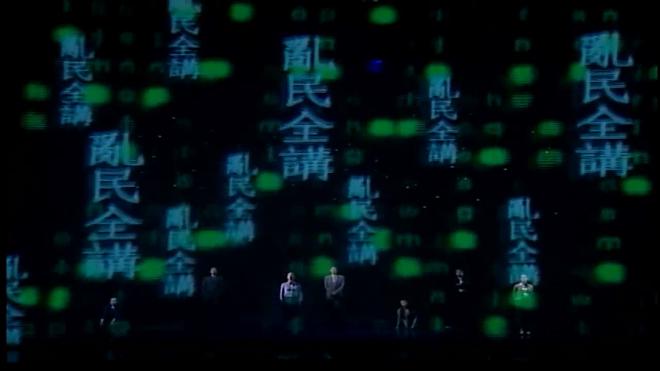
When the Ending Becomes the Opening ─ Reversing Theatrical Language #
Before the play begins, the stage lights are already on, the actors bow, and pre-recorded applause fills the audience. The play starts with a “curtain call.”
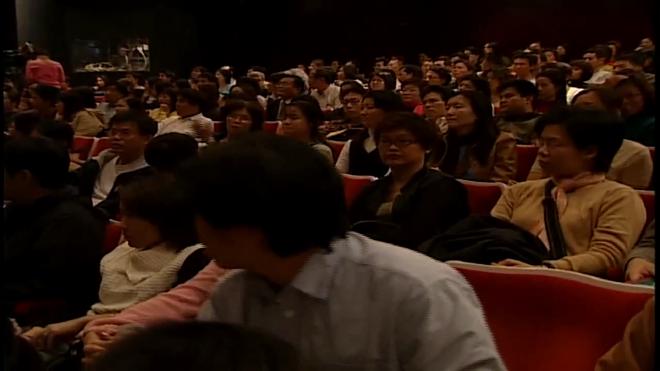
At this moment, the audience is struck with confusion—did I miss the entire performance? What happens next? This sense of disarray foreshadows the subversive nature of the play. It is not a work that follows traditional narrative logic but an experiment that constantly challenges the audience.
Disorder and Repetition: The Collage Aesthetics of Theater #
My love for Mumble Jumble goes beyond its sharp political satire to its unique narrative structure—a seemingly fragmented collage of short scenes that is, in fact, a masterfully orchestrated game of arrangement, interweaving different segments to form a deliberate “disorder.”
This narrative technique reminds me of how many writers create: inspiration rarely arrives linearly; they write whatever comes to mind and later rearrange it. This play does the same. Each segment appears independent but, through carefully designed repetition and contrast, immerses the audience in its narrative logic.
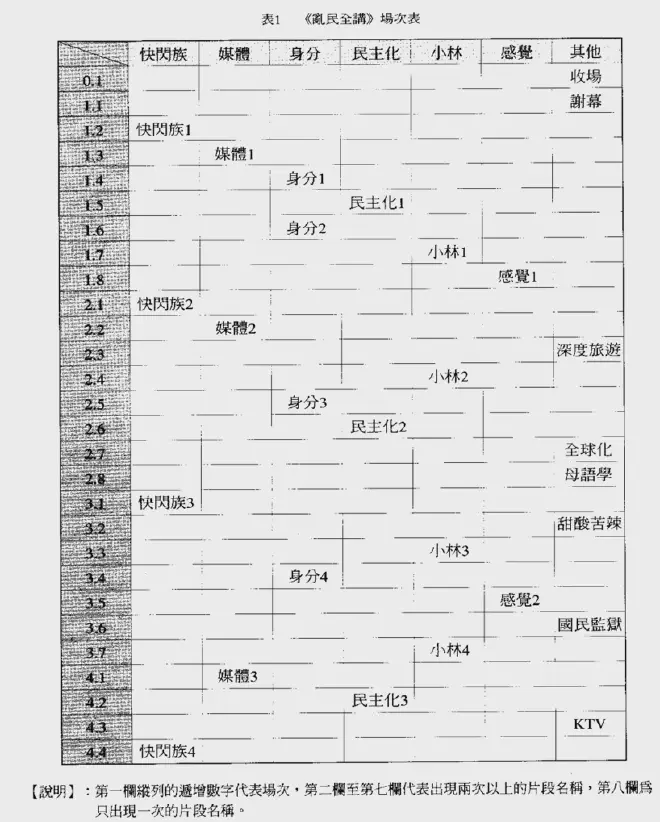
Image source: “Yu Shanlu: A Psychoanalytic Perspective on Mumble Jumble”
Examining its performance schedule, you’ll notice that some scenes are not performed just once but are cleverly dispersed throughout the play, even arranged in near-symmetrical patterns. The repetition builds up, causing certain images and lines to ferment in the audience’s mind—once is one meaning, ten times becomes an emphasis.
Moreover, abstract and obscure segments are often placed between straightforward, sharply critical ones, creating a stark contrast that oscillates the audience between thinking and feeling.
The Silent Flash Mob: A Rest in the Theatrical Symphony #
One of the most intriguing elements is the “Flash Mob.”
This is a series of almost wordless segments where actors express themselves through body movements and music. Flash Mob 1 is particularly thought-provoking. When a character tries to speak to the audience, others “shush” them into silence. This silence and suppression starkly contrast with the noisy political satire scenes, like a rest in a theatrical symphony.
The most ingenious design is its reappearance after the curtain call.
When the audience thinks everything is over, the Flash Mob actors remain on stage, silently watching the audience leave. This segment gains new meaning through the audience’s “exit behavior”—we think we are here to watch a play, but in reality, we are part of the play, being watched by those on stage.
This echoes the “Identity 2” segment. When a woman claiming to live in the virtual world says, “You think you are the audience, but actually, you are the actors,” the boundary between stage and reality blurs. The play on stage feels more real than what happens in real life.
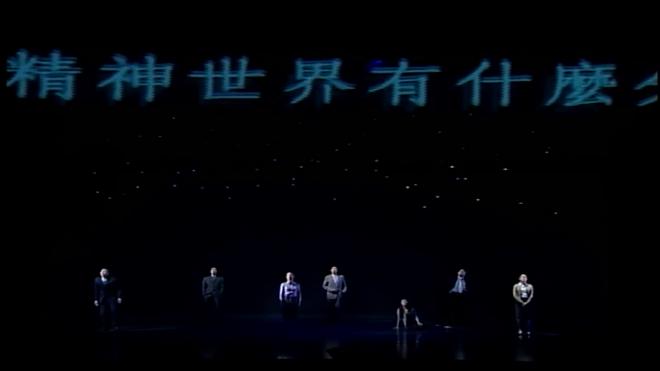
The imagery of the Flash Mob runs through the entire play. #
Flash Mob 2 depicts lovers about to part, exploring love and relationships; Flash Mob 3’s projection touches on the brutality of war and reality. While this play seems to focus on politics, through the Flash Mob’s performance, it truly concerns human relationships and identity in turbulent times.
Just like the “Identity” segment, which repeatedly asks: Who are we?
The characters in the play struggle between politics and emotions, and this seemingly absurd farce reflects our own confusion and struggles. Ultimately, Flash Mob 4 uses an invisible rope for tug-of-war—starting as a confrontation between two groups, it ends with a group fighting against an unseen force.
Who are they fighting against?
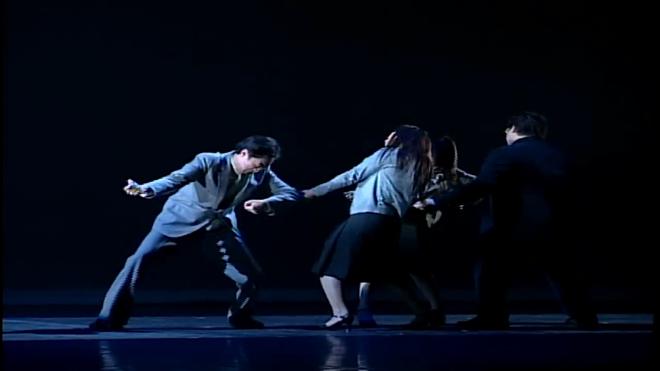
Yesterday, the Girl Singing Faye Wong Off-Key Committed Suicide #
Among the many segments of Mumble Jumble, “KTV” is perhaps the most intriguing. It is a nearly apolitical scene yet the most emotionally charged and unsettling climax of the play.
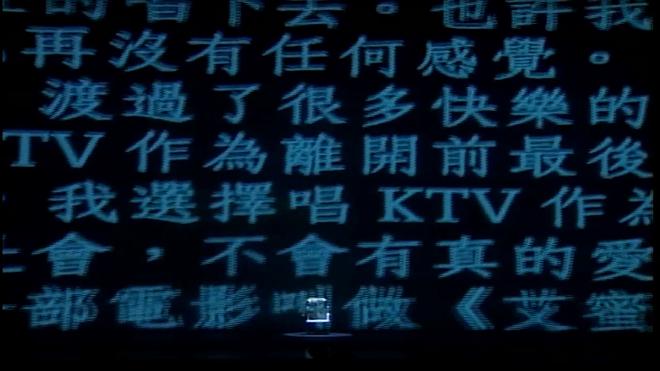
The setting is an ordinary KTV room—a group of colleagues drinking, chatting, and singing after work, creating a lively atmosphere. However, amidst the hustle and bustle, a lonely woman stands in the corner. She climbs onto a chair, holding a microphone, and sings Faye Wong’s “Red Bean.” Her voice trembles, off-key, and silent tears stream down her face, unnoticed by the laughter and chatter around her.
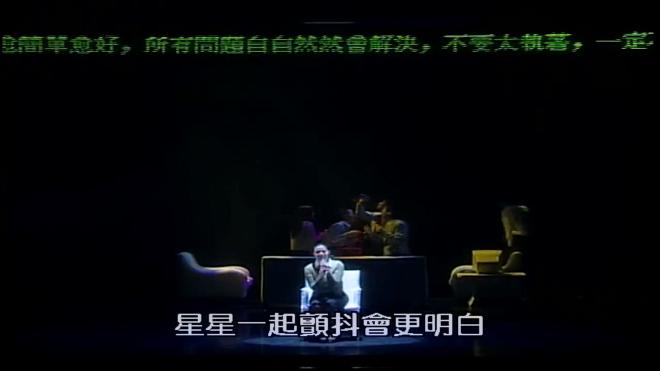
When the projection screen on stage lights up, everything changes.
“Because I have decided to leave this world.”
“I sit in this KTV room, preparing to sing karaoke for the last time in my life.”
“You will never like me.”
“I feel nothing anymore.”
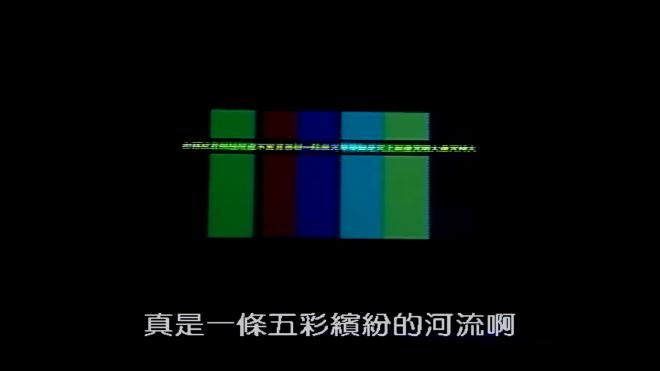
These words, like KTV lyrics, are not part of the song but the woman’s inner monologue. As her emotions intensify, the subtitles behind her flash faster and denser, layers of text almost swallowing her.
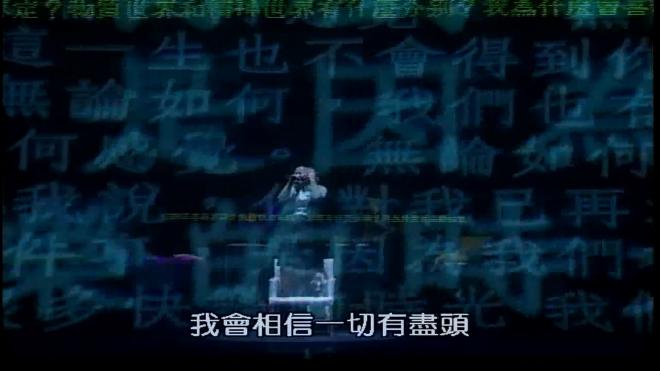
This scene evokes the “bullet screen culture” of modern social media, but these subtitles do not come from the audience; they come from the character’s inner world. The audience, like the others in the KTV room, is powerless—even indifferent to her breakdown.
Her story is left unresolved, even without a follow-up—we don’t know if she ultimately committed suicide, much like the sensational headlines of social news that often end inconclusively.
The Loneliness of KTV #
Structurally, this scene is placed near the end, representing the emotional peak of the play. After this climax, the play concludes.
The main theme of Mumble Jumble is political satire, deconstructing democracy, media, globalization, and social phenomena. Yet among the many sharply critical segments, the KTV scene has almost no agenda or clear political metaphor. Why is it here? Why is it the climax of the play?
This is the most intriguing arrangement of the play—it chooses vast blank spaces over clear answers. It selects an emotionally intense yet opinionless scene as the core turning point of the play, leaving interpretation to the audience.
One could sentimentally say that the KTV scene reveals the essence of modern society. Through the loneliness in the lively KTV setting, it hints at the isolation of modern individuals in an era where people seem harmonious but are distant in politics, thoughts, and emotions.
Alternatively, from a more meta perspective, this is the playwright’s intention. In a play named after the political satire show “全民亂講” (Everyone’s Talking Nonsense), a scene purely about emotions and devoid of opinions serves as the absurdity’s ultimate conclusion, making it even more representative.
But these are just my interpretations.
Regardless, its rich emotions profoundly impact the audience. The KTV scene is the one I recall most often—a deliberately blank segment.
The More Ambiguous, the More Poetic #
The blank spaces in this scene allow for multiple interpretations, reminding me of the “blue curtain” effect in Taiwanese internet culture. The “blue curtain” refers to when an author describes an ordinary curtain, but readers overanalyze it, attributing various metaphors: “The curtain is blue, symbolizing the protagonist’s melancholy and repression.”
My interpretation may very well be a trap set by the playwright—I, too, have started seeing “blue curtains.”
This is the most enchanting aspect of theatrical language—it doesn’t give you a standard answer but invites you to find your interpretation in the gaps of the text.
The same performance can evoke entirely different feelings and thoughts in each person.
Some see political satire, others see social indifference, and some simply think the KTV scene resembles a friend’s late-night breakdown.
In this era of short videos and fragmented information, visual works increasingly lean toward “information overload,” quickly telling you, “This is the answer.” As a classic in theatrical history, Mumble Jumble chooses “information blanks,” letting you find the answer yourself.
It tells you the play is over, but the problems remain unsolved.
It tells you the answer is not for it to give but for you to find.
Who are we in this era?
This play doesn’t spell it out, but it has handed the question to you.